


Dubai Relocation, Visas & Business Setup in 2026

Dubai Relocation, Visas & Business Setup in 2026: Legal Guide for Global Talents, Founders and Investors
Dubai continues to attract founders, investors, executives, digital professionals, and high-net-worth individuals who want a stable base for business, wealth planning, and family relocation. But moving to the UAE in 2026 is no longer just a visa application or a simple company registration.
For many people, Dubai relocation now involves several connected legal decisions: which visa to apply for, whether to set up a mainland or free zone company, how to structure ownership, how to open a bank account, how UAE Corporate Tax applies, and how to protect family assets, property, and business interests.
This guide explains the main UAE residency options, the legal and corporate steps behind relocation, and the key risks that foreign nationals should address before moving significant assets or business activity to Dubai.

Why Dubai Relocation Needs Legal Planning in 2026
Dubai offers long-term residency pathways, strong infrastructure, no personal income tax, international connectivity, and a growing business ecosystem. However, relocation becomes more complex when it involves:
- company formation;
- shareholder arrangements;
- Golden Visa or Green Visa eligibility;
- corporate bank account opening;
- UAE Corporate Tax registration and filing;
- amily sponsorship;
- estate planning and Powers of Attorney;
- cross-border ownership of assets.
The main mistake many newcomers make is treating each step separately. In practice, your visa, business licence, bank account, tax profile, property ownership, and family protection documents should work together.
Key point. The right UAE visa is only one part of relocation. For founders, investors, and senior professionals, the bigger question is whether the full legal structure supports your business, tax, banking, and asset protection goals.
Main UAE Residency Options for Global Talents in 2026
The UAE offers several residency routes depending on your profile, income, investment, employment, and business plans. Choosing the wrong route can cause delays, banking issues, or restrictions on future business activity.
1. UAE Golden Visa
The UAE Golden Visa is a long-term residency option designed for investors, entrepreneurs, exceptional talents, scientists, professionals, and other eligible categories.
For many foreign investors, the most relevant route is real estate investment. UAE government guidance refers to property ownership with a value of at least AED 2 million as one of the recognised Golden Visa pathways, subject to the applicable authority requirements and documentary evidence.
Golden Visa may be suitable for:
- real estate investors;
- entrepreneurs and startup founders;
- high-level executives;
- specialised professionals;
- scientists, doctors, researchers, and exceptional talents;
- families seeking longer-term UAE stability.
2. UAE Green Visa
The Green Visa is a self-sponsored residency route for selected skilled employees, freelancers, and self-employed individuals. It is particularly relevant for professionals who do not want their residency to depend entirely on a traditional employer sponsor.
Green Visa may be suitable for:
- skilled employees;
- freelancers with valid permits;
- self-employed professionals;
- consultants and independent specialists;
- professionals who want more flexibility in the UAE market.
However, eligibility depends on the applicant’s professional category, qualifications, income, permits, and supporting documents.
3. Dubai Remote Work Visa
Dubai’s remote work residency option allows eligible foreign nationals to live in Dubai while working remotely for an employer or business outside the UAE.
This route may be suitable for:
- digital nomads;
- software engineers;
- consultants;
- founders managing overseas companies;
- professionals testing Dubai before a permanent relocation or business setup.
The remote work route is useful for lifestyle relocation, but it is not always the best option if you plan to serve UAE clients, hire locally, or build a UAE-based company. In that case, business setup and a company-linked visa may be more appropriate.
4. Investor or Partner Visa Through UAE Company Formation
Foreign nationals who establish or invest in a UAE company may be eligible for residency through that company, subject to the rules of the relevant mainland or free zone authority.
This route is often used by:
- founders;
- consultants;
- trading companies;
- professional services firms;
- e-commerce businesses;
- holding or management structures;
- regional headquarters.
For business owners, the company setup route should be planned together with corporate tax, banking, shareholder documentation, and future hiring needs.
Which UAE Visa Is Right for You?
|
Profile |
Possible Route |
Key Legal Consideration |
|
Real estate investor |
Golden Visa |
Property value, ownership documents, mortgage/off-plan rules, family sponsorship |
|
Startup founder |
Company setup visa or Golden Visa |
Licence activity, shareholder documents, tax position, banking readiness |
|
Freelancer |
Green Visa or freelance permit route |
Permit validity, income proof, permitted activities |
|
Remote employee |
Dubai Remote Work Visa |
Foreign employer proof, income evidence, health insurance |
|
HNW individual |
Golden Visa + asset planning |
Property ownership, POA, wills, estate planning |
|
International company owner |
UAE company setup |
Mainland/free zone choice, corporate tax, substance, banking |
Practical tip. Before applying, confirm whether your visa route supports your real goal: living in Dubai, operating a UAE business, sponsoring family, buying property, opening bank accounts, or protecting assets.
Step-by-Step Dubai Relocation Process
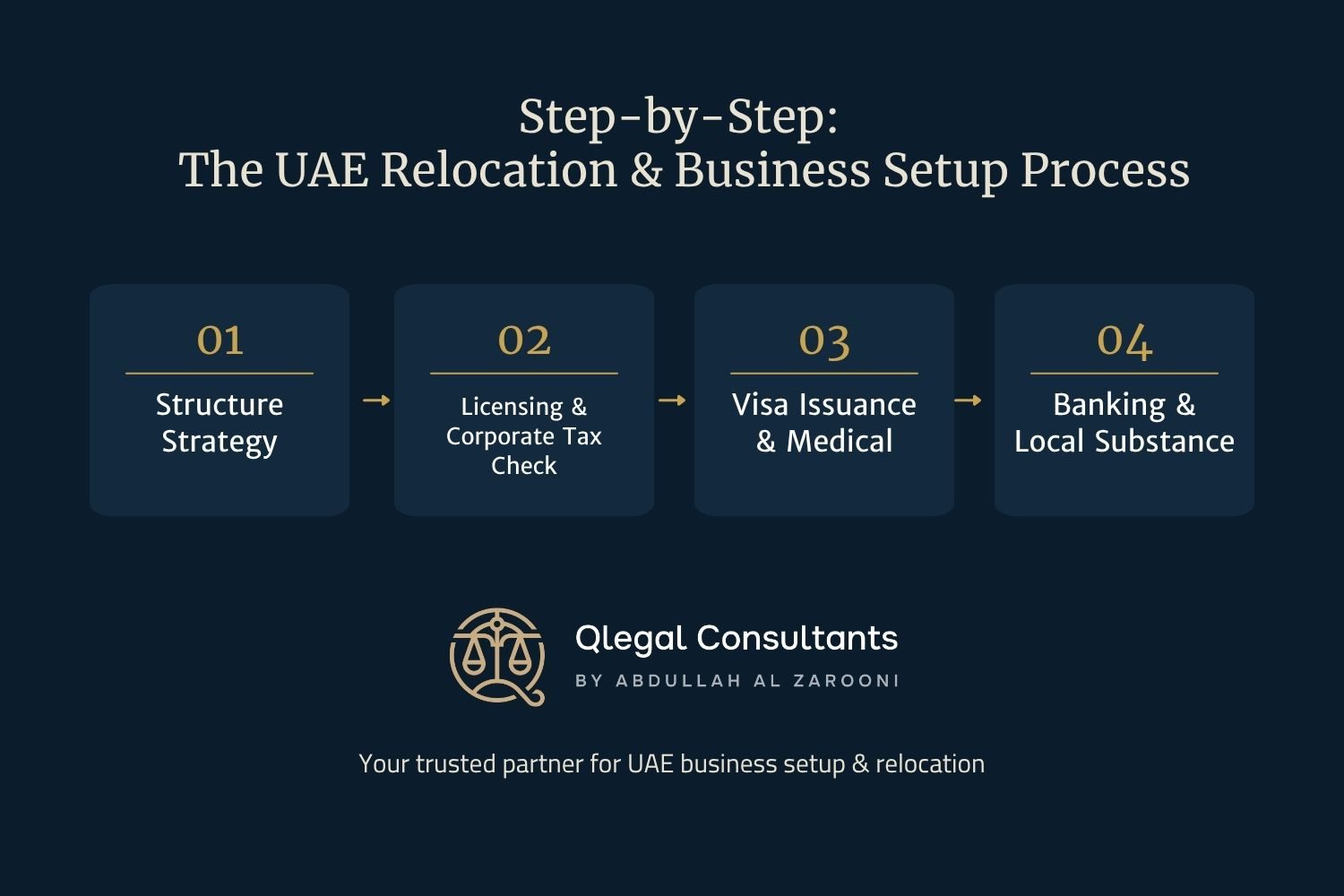
A successful relocation normally follows a structured process. The order matters, because a wrong early decision can affect licensing, banking, tax, and immigration later.
Step 1: Define Your Relocation Strategy
Before choosing a visa, clarify:
✓ Are you moving personally, commercially, or both?
✓ Will you work for a foreign employer or operate a UAE business?
✓ Do you need a UAE trade licence?
✓ Will you sponsor family members?
✓ Do you plan to buy property?
✓ Do you need a UAE bank account?
✓ Will you invoice UAE clients?
✓ Do you need asset protection or estate planning documents?
This step helps determine whether you need a Golden Visa, Green Visa, remote work visa, employment visa, or company-linked investor/partner visa.
Step 2: Choose the Correct Business Structure
If your relocation includes business activity, you need to choose between mainland and free zone setup.
Mainland companymay be suitable if you need broader UAE market access, local contracts, government-related work, or certain regulated activities.
Free zone companymay be suitable for international trade, consulting, digital services, holding structures, or businesses that can operate within the permitted free zone framework.
The right choice depends on:
✓ business activity;
✓ target clients;
✓ office requirements;
✓ visa allocation;
✓ ownership structure;
✓ corporate tax position;
✓ banking expectations;
✓ future expansion plans.
Step 3: Select the Right Licence Activity
The licence activity must match the real business model. A mismatch can create problems with:
✓ bank account opening;
✓ invoicing;
✓ tax classification;
✓ visa eligibility;
✓ commercial contracts;
✓ regulatory approvals.
For example, “management consultancy,” “IT services,” “marketing services,” “e-commerce,” “general trading,” and “investment-related” activities can have very different legal and banking implications.
Step 4: Prepare Corporate Documents
Depending on the structure, founders and investors may need:
✓ Memorandum or Articles of Association;
✓ shareholder agreement;
✓ board or shareholder resolutions;
✓ manager appointment documents;
✓ Ultimate Beneficial Owner declarations;
✓ source-of-funds documents;
✓ commercial lease or office agreement;
✓ Power of Attorney for remote handling;
✓ nominee or authorised signatory documents, where legally appropriate.
This is where many relocation projects become legal rather than administrative.
Step 5: Apply for Residency and Emirates ID
Once the corporate, employment, property, or self-sponsored basis is confirmed, the residency process usually involves:
✓ entry permit or status adjustment;
✓ medical fitness test;
✓ Emirates ID biometrics;
✓ visa issuance;
✓ Emirates ID delivery;
✓ family sponsorship, if applicable.
Requirements vary depending on the visa route and authority.
Step 6: Open Personal and Corporate Bank Accounts
Banking is often the most difficult practical stage of relocation. UAE banks may request detailed evidence of:
✓ source of funds;
✓ source of wealth;
✓ business model;
✓ expected transactions;
✓ client and supplier countries;
✓ shareholder background;
✓ company substance;
✓ office address;
✓ contracts or invoices;
✓ tax residency position.
A weak or inconsistent file can lead to delays or rejection. For business owners, the bank account strategy should be prepared before company incorporation, not after.
UAE Corporate Tax: Why It Matters for New Residents and Companies
The UAE Corporate Tax regime applies to many UAE companies and certain business activities. The Ministry of Finance confirms that UAE Corporate Tax applies broadly to UAE companies and other juridical persons, and that Free Zone Persons are also within the scope of Corporate Tax, although qualifying free zone income may benefit from a 0% rate where the legal conditions are met.
For many businesses, the standard UAE Corporate Tax rate is 9% on taxable income above AED 375,000. This means founders should not choose a UAE structure based only on setup cost or visa convenience.
Key questions include:
- Will the company be mainland or free zone?
- Will it qualify for free zone tax treatment?
- Where will clients be located?
- Will the company have UAE-sourced income?
- Will the owner manage the company from the UAE?
- Does the company need substance in the UAE?
- Are transfer pricing or related-party rules relevant?
- When must the company register and file?
Key point.A company can be easy to incorporate but difficult to bank, operate, or defend from a tax perspective. Corporate tax planning should be part of the setup decision from the beginning.
The New UAE Civil Transactions Law: Why Relocating Investors Should Pay Attention
The UAE has introduced Federal Decree-Law No. 25 of 2025 issuing a new Civil Transactions Law, with the law reported to come into effect on 1 June 2026. UAE government materials describe the new law as part of a wider legal modernisation framework and refer to changes affecting areas such as pre-contractual negotiations and disclosure obligations.
For relocating investors, founders, and property buyers, this matters because civil law principles affect many everyday legal relationships, including:
- contracts;
- property transactions;
- business negotiations;
- civil liability;
- damages;
- obligations;
- asset-related disputes.
Relocation is not only an immigration matter. If you are buying property, entering into a shareholders’ agreement, signing a commercial lease, acquiring a business, or appointing someone to act on your behalf, your documents should be reviewed under the applicable UAE legal framework.
Asset Protection, POA and Estate Planning for Expats
Many expats move to Dubai with assets spread across several jurisdictions: UAE property, foreign bank accounts, company shares, crypto assets, investment portfolios, and family-owned businesses.
This creates practical legal questions:
- Who can act if you are outside the UAE?
- Who can sign property or company documents on your behalf?
- What happens to UAE assets if you pass away?
- Are your foreign wills recognised for UAE assets?
- Do you need a DIFC Will, Abu Dhabi Will, or other estate planning document?
- Should your spouse, partner, or trusted representative hold a Power of Attorney?
- Are company shares properly documented?
When a Power of Attorney Is Useful
A UAE Power of Attorney can be useful when you need someone to handle:
- property purchase or sale;
- company incorporation;
- bank-related formalities;
- court or legal representation;
- visa and immigration steps;
- document collection;
- vehicle sale or registration;
- government authority filings.
For international clients, POA planning is especially important because it allows relocation and business setup steps to continue even when the client is outside the UAE.
When Estate Planning Should Be Reviewed
Estate planning should be considered if you have:
- UAE real estate;
- UAE company shares;
- UAE bank accounts;
- minor children;
- assets in multiple countries;
- a spouse or partner who needs legal clarity;
- family members outside the UAE;
- complex ownership structures.
Practical warning.Do not assume that a foreign will, foreign company document, or informal family arrangement will automatically solve UAE asset issues. UAE-specific legal review is strongly recommended.
Common Relocation Mistakes to Avoid
Mistake 1: Choosing a Visa Before Choosing the Strategy
A visa may solve residency but not business, tax, banking, or asset protection. Start with the full relocation goal.
Mistake 2: Setting Up the Cheapest Company
Low-cost setup can become expensive if the licence activity is wrong, the visa allocation is insufficient, or banks reject the company profile.
Mistake 3: Ignoring UAE Corporate Tax
Many founders still assume the UAE is “tax-free” for all business purposes. That is no longer a safe assumption for companies.
Mistake 4: Opening a Company Without Banking Preparation
Banks want consistency between the licence, business model, shareholders, transactions, and source of funds. Prepare the file early.
Mistake 5: Buying Property Without Legal Review
Golden Visa eligibility, title documents, developer obligations, mortgage structure, off-plan terms, and POA arrangements should be checked before payment.
Mistake 6: Leaving Family Protection Until Later
Wills, guardianship planning, POA documents, and company succession should be addressed before a problem arises.
Practical Checklist Before Moving to Dubai
For Founders and Entrepreneurs
- Confirm whether mainland or free zone setup is better for your business
- Choose the correct licence activity
- Prepare shareholder and management documents
- Check UAE Corporate Tax obligations
- Build a bank-ready company profile
- Prepare source-of-funds and source-of-wealth documents
- Confirm visa allocation and family sponsorship options
- Use POA if you need remote setup support
For Real Estate Investors
- Verify whether the property supports your intended visa route
- Review title, developer, SPA, mortgage, or escrow documents
- Check whether the investment value meets the relevant threshold
- Confirm ownership structure before purchase
- Prepare POA if signing remotely
- Review inheritance and estate planning implications
- Keep payment records and official documents
For Skilled Professionals and Freelancers
- Check Green Visa or freelance permit eligibility
- Confirm qualification and income requirements
- Review whether you can legally invoice UAE clients
- Prepare employment, freelance, or business documents
- Check health insurance and Emirates ID requirements
- Consider whether a company setup is more suitable long term
For Remote Workers
- Confirm that your employer or business is outside the UAE
- Prepare proof of remote work and income
- Check health insurance requirements
- Understand the limits of remote work residency
- Consider whether future UAE business activity requires a licence
How QLegal Consultants Can Help
Relocation to Dubai is not only about obtaining a visa. It is about building a legally secure foundation for your life, business, property, and family in the UAE.
At QLegal Consultants, we assist individuals, founders, investors, and companies with:
- UAE relocation strategy;
- Golden Visa, Green Visa, remote work and investor visa guidance;
- mainland and free zone business setup;
- corporate structuring and shareholder documentation;
- UAE Corporate Tax readiness from a legal structuring perspective;
- Power of Attorney drafting and execution;
- property transaction legal support;
- contract review and legal advisory;
- family asset protection and estate planning coordination;
- legal documentation for bank account opening;
- dispute prevention and risk review.
______________________________________________________
Contact us. If you are planning to relocate to Dubai, invest in UAE property, establish a company, or protect family assets, speak with QLegal Consultants before making binding commitments.
Need a Legal Consultation?
Planning your Dubai relocation, visa, business setup or asset protection strategy?
Contact QLegal Consultants today for tailored UAE legal support.
Call / WhatsApp: +971 56 991 6077
Email: info@qlegal.ae
Location: Dubai, United Arab Emirates
** Disclaimer: This article is for general informational purposes only and does not constitute legal advice. UAE immigration, corporate, tax, real estate, and civil law rules may change, and the correct legal position depends on the facts of each case, the emirate involved, the authority handling the application, and the documents signed by the parties. You should seek advice from a qualified UAE legal professional before taking action.**

Frequently Asked Questions
What is the best visa for moving to Dubai in 2026?
Can I get a UAE Golden Visa by buying property?
Is the Green Visa better than an employment visa?
Can I live in Dubai while working for a foreign company?
Do I need a UAE company to move to Dubai?
Is Dubai business setup enough to open a bank account?
Does UAE Corporate Tax apply to free zone companies?
Should I prepare a Power of Attorney before relocating?
Do expats need estate planning in the UAE?
When should I speak to a UAE legal consultant?


